Should You Learn Full Stack Development in 2026? Honest Guide
Quick Answer
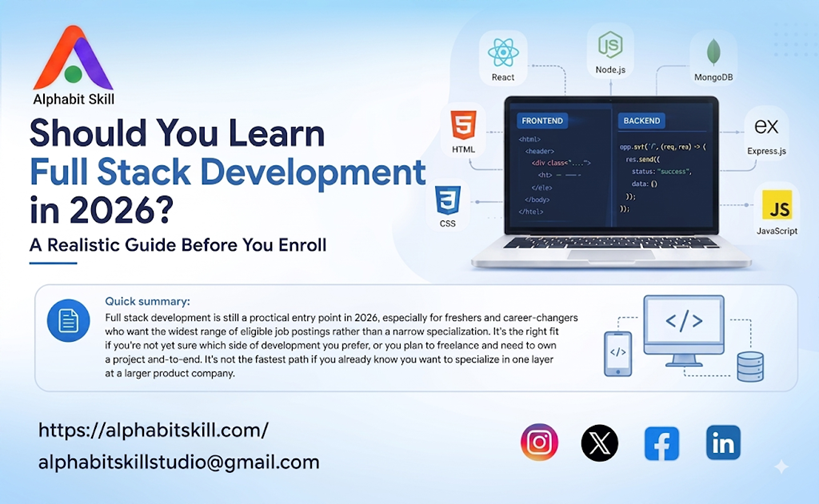
Yes — Full Stack Development remains one of the best career choices in 2026 for students, freshers, career changers, and aspiring freelancers. It teaches you to build complete web applications by combining front-end and back-end development, opening doors to a wide range of entry-level software roles. Rather than specializing too early, it gives you the complete application lifecycle — UI design, database management, and deployment — all in one skill set.
💡 Key Takeaway: If you're unsure whether to go front-end or back-end, Full Stack is a practical starting point that keeps your options open.
Why Is Full Stack Development Still in Demand?
Businesses of every size — startups, healthcare, education, e-commerce, finance, manufacturing — now depend on web applications to run their operations. While large companies split front-end and back-end teams, smaller and growing businesses value developers who can work across the whole stack. For beginners, this means broader exposure to client-side and server-side technologies, plus the flexibility to specialize later based on interest and market demand.
💡 Key Takeaway: Full Stack gives career flexibility without limiting future specialization.
Is It Right for Beginners?
A Full Stack Developer doesn't need to master every language or framework — they need to understand how the pieces fit together: interface, back-end processing, database, APIs, and live server, all working as one system (think: ordering food online).
💡 Key Takeaway: You need to understand the whole flow, not memorize every tool.
Skills Employers Value Beyond Coding
Problem-solving and logical thinking Debugging Git/version control Understanding APIs and databases Team collaboration Adapting to new tools
💡 Key Takeaway: Employers hire problem-solvers, not just code-writers.
The Learning Journey
Fundamentals — how websites are structured and respond to devices Interactivity — JavaScript, forms, dynamic content Front End + Back End — servers, databases, APIs Real Applications — projects, debugging, deployment, professional workflows
💡 Key Takeaway: Build skills step by step — don't rush the syllabus.
Why Real Projects Matter More Than Certificates A portfolio of live projects and documented GitHub work proves your ability far better than a certificate. Real projects sharpen debugging skills, build interview confidence, and give recruiters something concrete to evaluate.
👉 Explore the Complete Full Stack Learning Roadmap
Full Stack vs Front-End vs Back-End
Your Goal Recommended Path Build complete websites/apps Full Stack Development Focus on UI/UX Front-End / UI-UX Databases, APIs, server logic Back-End / Database Freelance or build your own product Full Stack Development Join startups/growing companies Full Stack Development Specialize in one domain Front-End or Back-End
💡 Key Takeaway: Unsure which path? Full Stack gives you the broadest foundation.
Common Mistakes Beginners Make
Chasing certificates over real projects Learning too many technologies at once Skipping practical, hands-on building Comparing progress with others instead of staying consistent
💡 Key Takeaway: Consistency and fundamentals beat speed.
Career Opportunities
Full Stack Developer, MERN Stack Developer, React Developer, Node.js Developer, PHP Laravel Developer, Software Engineer, Web App Developer, JavaScript Developer, WordPress Developer, Freelance Web Developer — with growth paths into senior developer, tech lead, architect, or engineering management.
👉 Explore the Full Stack Development Course
Salary Expectations in 2026
Salaries vary by location, skills, and portfolio strength. Developers with real project experience consistently outperform those with theory alone. Focus on fundamentals and a strong portfolio rather than chasing headline salary numbers — long-term growth comes from continuous learning.
Is Full Stack Development Right for You?
Good fit if you:
Want to understand how full web apps are built
Enjoy both creative and logical problem-solving
Want flexibility across technologies
Plan to freelance or build your own products
Haven't decided between Front-End and Back-End
If you already know you love UI design or server-side engineering specifically, a specialized path may suit you better.
FAQs
Is full-stack development worth learning in 2026?
Yes — businesses keep investing in web products, and full-stack developers who understand both sides remain valuable.
Can beginners learn it?
Yes. Most developers start with little or no experience; structured learning and real projects make the path manageable.
Do I need a CS degree?
No — employers increasingly focus on skills, portfolio, and problem-solving ability.
How long until I'm job-ready?
Depends on dedication and approach; consistent practice and real projects matter more than syllabus speed.
What should I focus on first?
Strong fundamentals — they make picking up new frameworks much easier later.
👉 Book a Free Career Counselling Session: https://alphabitskill.com/register